Inspired by By Dr. Andrew Huberman
Inflammation is one of those biological processes that’s both a hero and a villain. It’s essential for fighting off infections or healing a cut, but when it lingers too long, it’s tied to chronic conditions like arthritis, heart disease, and even mood disorders. For centuries, acupuncture has been touted as a way to manage pain and inflammation, but the “how” has always been a bit of a black box. A study out of Harvard, led by neuroscientist Qiufu Ma and his team, is finally shedding light on this—pinpointing how acupuncture taps into specific neural pathways to dial down inflammation. Let’s dive into what they found and what it means for you.
The Study: Acupuncture Meets Neuroscience
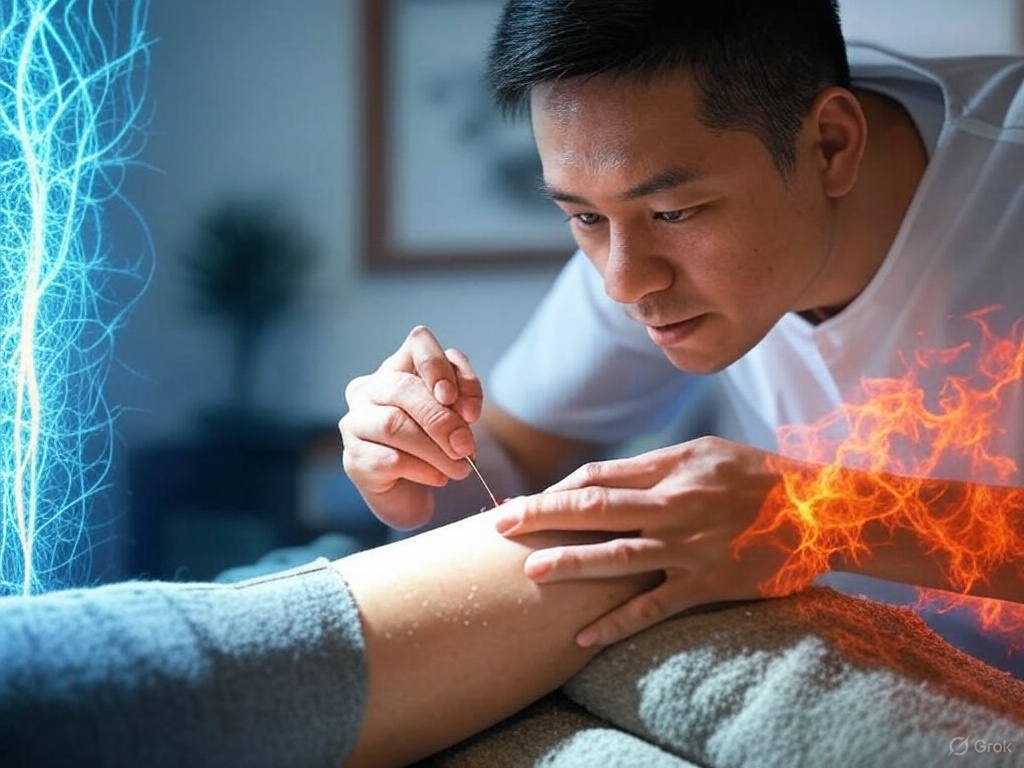
Back in 2021, the Harvard Gazette reported on this groundbreaking work from Ma’s lab, published in Nature. The team wasn’t just sticking needles in random spots—they were testing a precise hypothesis about how acupuncture interacts with the nervous system. Using mouse models, they focused on a technique called electroacupuncture, where a mild electric current is added to the needles to amp up the stimulation. Their target? A specific spot on the hind leg of these mice, rich with sensory neurons that connect to deeper neural circuits.
Here’s where it gets interesting. They found that stimulating this spot—roughly equivalent to the ST36 acupoint in traditional Chinese medicine—triggered a cascade of signals that reduced inflammation. But it wasn’t magic; it was biology. The key players were a subset of sensory neurons called PROKR2-positive neurons, which are wired into the vagus nerve and a pathway that ultimately talks to the adrenal glands. Stimulate these neurons just right, and you get a drop in pro-inflammatory cytokines—those molecules like IL-6 and TNF-alpha that drive swelling and pain—while anti-inflammatory signals ramp up. In their experiments, this protected the mice from a deadly inflammatory storm called cytokine release syndrome.
The Neural Pathway: A Two-Step Dance
So, how does a needle in the leg calm inflammation across the body? It’s all about the wiring. The PROKR2 neurons in that hind leg spot send signals up the spinal cord to a region in the brainstem called the dorsal motor nucleus of the vagus. This is a control center for the vagus nerve, which stretches from your brain to your gut and beyond. From there, the vagus nerve talks to the adrenal glands—those little hormone factories above your kidneys—prompting them to release anti-inflammatory compounds like dopamine and cortisol, but in a controlled, beneficial way.
What’s wild is the specificity. The Harvard team showed that this only worked when they hit the right spot with the right intensity. Too weak, and nothing happened. Too strong—or in the wrong place, like the abdomen—and it backfired, ramping up inflammation instead. It’s like tuning a guitar string: there’s a sweet spot where everything resonates perfectly.
Why This Matters: From Mice to Humans
You might be thinking, “Cool, they saved some mice. What’s the human angle?” Great question. This study isn’t just about acupuncture’s past—it’s about its future. Chronic inflammation is a massive driver of disease, and our current options, like steroids or anti-inflammatory drugs, often come with side effects: gut issues, immune suppression, the list goes on. If we can figure out how to target these neural pathways precisely—whether with needles, electricity, or something else—we might have a new tool that’s less invasive and more in tune with the body’s natural systems.
The researchers are already hinting at clinical potential. Electroacupuncture isn’t some far-off sci-fi concept—it’s been used for pain management in humans for years. Ma’s team suggests that with the right protocols, it could be optimized for inflammatory conditions like rheumatoid arthritis or even sepsis. And it’s not just about acupuncture. This work opens the door to other neuromodulation techniques—think vagus nerve stimulation devices—that could mimic these effects without a needle in sight.
Practical Takeaways: What You Can Do Now
While we’re not all running out to get electroacupuncture tomorrow, there’s a lot here to play with. The vagus nerve is a big player in this story, and you can nudge it without fancy equipment. Slow, deep breathing—say, 5 seconds in, 5 seconds out—activates the parasympathetic nervous system, which the vagus nerve runs. Studies show this can lower inflammatory markers. Cold exposure, like a quick cold shower, does something similar by jolting your vagus nerve into action. Even exercise—especially moderate cardio—seems to tap into these anti-inflammatory pathways.
If you’re curious about acupuncture, this study suggests finding a practitioner who knows their stuff—someone who understands the ST36 point (it’s just below your knee, laterally). But don’t overthink it: the takeaway isn’t that acupuncture is the cure-all. It’s that your nervous system is a powerful lever for controlling inflammation, and we’re just starting to learn how to pull it.
The Big Picture
What I love about this Harvard study is how it bridges ancient practice with modern neuroscience. They’re not saying acupuncture is perfect or that it’s the only answer—they’re showing us the mechanism, the “why” behind it. Published in Nature in 2021, this work is a stepping stone, and I’d bet my morning coffee we’ll see more studies building on it in the next few years. For now, it’s a reminder that your brain and body are in constant dialogue, and sometimes, a little tweak in the right place can make a big difference.
Next time you’re stressed or feeling inflamed—literally or figuratively—take a deep breath, hit the cold water, or maybe even try a needle. Your nervous system might just thank you.
Thanks for reading,
At this clinic, I practice an integrative approach to Acupuncture, mixing different systems (Balance Method, Tung, Motor Point Acupuncture, Dry Needling) depending on what the people need, however primarily centred in the Neoclassical Acupuncture paradigm.
Acupuncture in Hobart and Kingston